

Whales and Wonder
Louise Reeve here – I’m sharing some of my thoughts via the blog. This is from a service I’ve led a few times on ‘Whales and Wonder’.
“Recently, on the UK Unitarian Facebook page, someone posted the question: “Should worship involve the head, the heart or both?” One of many responses to this question was from someone concerned that there was a tendency, if we’re not careful, to produce a ‘themed lecture with hymns’.
I tried to bear that in mind when I put this service together. Because I really could do a lecture about whales. I could just talk about them all morning. They are among the most wonderful creatures on earth. I could tell you how the beluga whale is the only whale to have a head that is not fused to its neck and can look at things without having to move its entire body, and that it has the nickname of the sea canary, because of its beautiful chirruping song. I could tell you about the new species of deep-diving American whale that was discovered only a few weeks ago.
We could think of all the sights we have seen recently on David Attenborough’s marvellous documentaries in the past few years. The clever humpback whales who blow nets of bubbles to herd fish into their mouths. The pods of fake killer whales who appear to have formed friendships and hunting partnerships with bottlenose dolphins. The mighty grey sperm whales who sleep vertically in the water and dive over 1000m into the lightless deep ocean to hunt giant squid with echolocation.
But this time together is for our spirits as well as our minds. We’ve heard earlier about the role of the whale in the spiritual traditions of the Abenaki people of Canada. Whales feature often in the spiritual traditions of indigienous peoples around the world. When I asked on the same UK Unitarians discussion page ‘Has anyone got any thoughts about whales and spirituality’, the first thing that came back was ‘Watch the film, Whale Rider’!”. If you haven’t seen it, it’s a New Zealand film about a twelve-year-old Māori girl whose ambition is to become the chief of her tribe, a position traditionally held only by men, who descend from their legendary ancestor, who – like Glooscap – rode a whale, as he travelled from Hawaii to New Zealand to found a new nation.
When I think of the Christian tradition I grew up with, the first thing that comes to mind is somewhat less optmistic. Like many Sunday school kids, I spent a certain amount of time singing the song, “Have you heard the tale, of Jonah and the whale, way down at the bottom of the ocean?” It’s the most famous whale in the Bible, spoiled only slightly by the fact that it’s as likely to be a ‘giant fish’ as a whale, depending on your translation. And also by the fact that those of us who were a little older and had started studying biology realised that whales were not in fact hollow, like the whale in Disney’s Pinocchio, and that getting swallowed by a whale would in fact be really unpleasant. (Less fun fact about sperm whales; they’re the only creatures on earth capable of swallowing an adult human being whole.)
Jonah’s prayer is one of the most powerful expressions of faith in the face of despair and hopelessness in the Bible. When he had been cast overboard by the sailors of the ship he was travelling on, who were terrified of the storm he had brought on them by disobeying God, he was swallowed by the whale, and prayed:
1 Then Jonah prayed to the LORD his God from the belly of the whale, 2 saying,
“I called out to the LORD, out of my distress,
and he answered me;
out of the belly of Sheol I cried,
and you heard my voice.
3 For you cast me into the deep,
into the heart of the seas,
and the flood surrounded me;
all your waves and your billows
passed over me.
4 Then I said, ‘I am driven away
from your sight;
yet I shall again look
upon your holy temple.’
5 The waters closed in over me to take my life;
the deep surrounded me;
weeds were wrapped about my head
6 at the roots of the mountains.
I went down to the land
whose bars closed upon me forever;
yet you brought up my life from the pit,
O LORD my God.
7 When my life was fainting away,
I remembered the LORD,
and my prayer came to you,
into your holy temple.
8 Those who pay regard to vain idols
forsake their hope of steadfast love.
9 But I with the voice of thanksgiving
will sacrifice to you;
what I have vowed I will pay.
Salvation belongs to the LORD!”
10 And the LORD spoke to the whale, and it vomited Jonah out upon the dry land.”
There is another mysterious whale-creature in the Bible – Leviathan.
Leviathan appears in part God’s reply to Job’s complaint. Job was a man who had enjoyed great good fortune in life, until God tested his faith by permitting Satan to take away his riches, his family and his health. Though Job originally remains faithful, he eventually complains at this injustice saying: “I loathe my very life, therefore I will give free rein to my complaint and speak out in the bitterness of my soul. I say to God: ‘Do not declare me guilty, but tell me what charges you have against me. Does it please you to oppress me, to spurn the work of your hands, while you smile on the plans of the wicked?’
When I was younger, I found God’s reply very difficult to read, because it is not comforting at all. God does not explain anything to Job, but says, in essence, that a human mind cannot hope to understand the ways of the Creator. Part of God’s reply is to say:
“Can you pull in Leviathan with a fishhook
or tie down its tongue with a rope?
2 Can you put a cord through its nose
or pierce its jaw with a hook?
3 Will it keep begging you for mercy?
Will it speak to you with gentle words?
4 Will it make an agreement with you
for you to take it as your slave for life?
5 Can you make a pet of it like a bird
or put it on a leash for the young women in your house?
6 Will traders barter for it?
Will they divide it up among the merchants?
7 Can you fill its hide with harpoons
or its head with fishing spears?
8 If you lay a hand on it,
you will remember the struggle and never do it again!
9 Any hope of subduing it is false;
the mere sight of it is overpowering.
10 No one is fierce enough to rouse it.
Who then is able to stand against me?
11 Who has a claim against me that I must pay?
Everything under heaven belongs to me.”
Again, it’s an ambiguous whale, and whilst ‘leviathan’ these days is a term often used to refer to whales, many people translate it as a crocodile. No matter!
As an adult, I still don’t find the book of Job comforting, but I now find it closer to my own views on spirituality. We know now that our own universe contains many mysteries we do not understand. We cannot touch dark matter, nor see infrared or ultra-violet. Humans can only hear part of a whale’s song; we are not able to hear the lowest of the whale frequencies. Humans hear low frequency sounds starting at about 100 Hz, whereas whales sing as low as 30Hz. And indeed, whales themselves are mysterious and powerful creatures. One of the most famous whales of all, Moby-Dick, is a source of terror for the whaling crews trying to kill him, and even Captain Ahab, who has sworn revenge on the whale for biting off his leg, is simultaneously enraged by the whale and fascinated by its sheer size and essential otherness:
“It was a black and hooded head; and hanging there in the midst of so intense a calm, it seemed the Sphynx’s in the desert. “Speak, thou vast and venerable head,” muttered Ahab, “which, though ungarnished with a beard, yet here and there lookest hoary with mosses; speak, mighty head, and tell us the secret thing that is in thee. Of all divers, thou hast dived the deepest.
That head upon which the upper sun now gleams, has moved amid this world’s foundations. Where unrecorded names and navies rust, and untold hopes and anchors rot; where in her murderous hold this frigate earth is ballasted with bones of millions of the drowned; there, in that awful water-land, there was thy most familiar home. Thou hast been where bell or diver never went; hast slept by many a sailor’s side, where sleepless mothers would give their lives to lay them down. Thou saw’st the locked lovers when leaping from their flaming ship; heart to heart they sank beneath the exulting wave; true to each other, when heaven seemed false to them.
Thou saw’st the murdered mate when tossed by pirates from the midnight deck; for hours he fell into the deeper midnight of the insatiate maw; and his murderers still sailed on unharmed—while swift lightnings shivered the neighboring ship that would have borne a righteous husband to outstretched, longing arms. O head! thou hast seen enough to split the planets and make an infidel of Abraham, and not one syllable is thine!”
‘Moby-Dick, or The Whale’, Herman Melville
I believe that the book of Job, echoed in Melville’s description of the otherworldliness – to humans – of the whale’s habitat, reminds us that we are part of the creation, but not the point of it. The nice idea that the world was created especially for our benefit is one that has to go. When we ditch our anthropomorphic worldview, we become closer to understanding ourselves and our world. And, in my view, God, who I see as the maker of all things, but not a father-God. You may or may not agree with me there, but I think all of us here are seeking some form of deeper spiritual knowledge, and as Unitarians, if there’s one thing we are committed to, it’s increasing our knowledge.
We also see whales more closely. Where we previously saw monsters, or dumb animals to be exploited for lamp oil and ribs for corsets, we see what might be the closest thing to an alien intelligence we are likely to encounter any time soon. What is it like to be a whale? To have a body the size of a ship, with arteries a human could swim through? To find your food by echolocation, not sight? To be continually bathed in sound, continually communicating with your family and fellows, never apart from them?
Whales also remind us of our unhappy power to cause immense destruction of the natural world. Humans have hunted whales for almost as long as we have existed, and whilst that was understandable when we needed to survive, there is a great difference between a tradition of occasionally killing one or two whales, which many cultures revere as a spiritual tradition, and do not carry out lightly or casually, and the wholescale industrial slaughter our species has gone in for over the past couple of centuries. The founder of the Sea Shepherd activist group, Captain Paul Watson, wrote this poem:
“Primate Monsters of the Deep (excerpt)”
In ancient times Leviathan was a mystery
A mythic creature of wonder much revered
But humankind was seeking dominance
And thus began a bloody history
And mankind became a species to be feared,
With whales dying in pain for wealth and prominence
Intelligence willfully destroyed to read books
Moby Dick read by the light of burning whales,
Without a thought, blind to the connections
By death’s bright light, is read another book
Thou shalt not kill is one of the lying tales.
We define what is right by biased selections.”
Still more horrifying is the unthinking harm we can do. None of us here intended to fill the oceans with plastic, or make them so noisy with the sounds of our giant boats, oil rigs and submarines that it is hard for sea creatures to navigate them or communicate with each other. Yet many of us were moved to tears by David Attenborough’s documentary showing a mother whale mourning the loss of her calf, which probably died through ingesting milk filled with plastic and chemicals.
I don’t pretend an easy answer to any of these problems, but I also don’t want to counsel despair. We can change. We have recently seen huge campaigns to limit single-use plastics and clear up litter. Wind power is likely to become the main source of power in the British Isles over the next few decades. Humans can go to great lengths to protect living beings, as well as harm them.
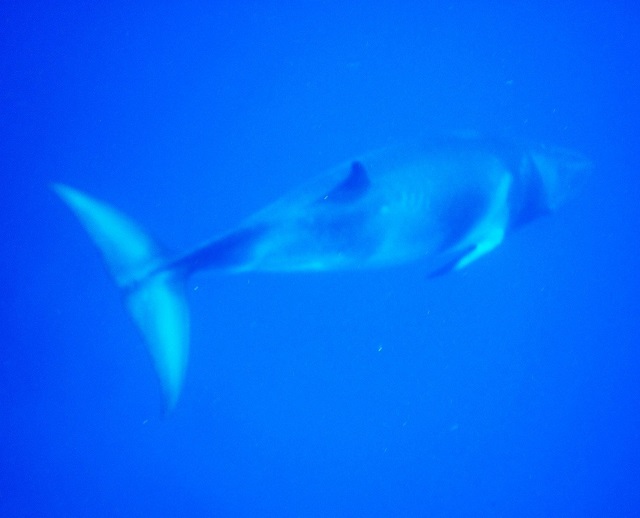
Through knowing our fellow creatures better, we come to know our world and ourselves better. One final story. Nearly five years ago, I dived on the Great Barrier Reef in Australia. As I surfaced from my dive, one of the boat crew approached me and said quietly: “Take off your diving jacket, but keep your wetsuit and fins, put on a snorkel, and get back in the water – there are five minke whales swimming behind the boat.” One of those whales is pictured on the order of service. I hung in the water behind the boat, watching the whales swimming back and forth unhurriedly.
One whale was accompanied by a much smaller whale, which I suspect was the whale equivalent of a teenager. As the two patrolled up and down, it was hard not to imagine the older whale pointing a fin at me and saying to the younger whale: ‘And these funny-looking things that think they can swim are called humans…’
You shouldn’t anthropomorphise too much. But as I looked into the whales’ eyes, I knew there were fellow minds looking back at me. Then they departed into the blue.”
