

UU “Leading Into the Future” Day 2, Friday 27th October – Worship and Keynote Speaker Bayo Akomolafe, Keynote Panel on Theological Education

We began with a grounding with worship morning session, 9.30am at the Unitarian Church of Prague. (Actually we began in the hotel with a bunfight over the coffee and croissant breakfast buffet. Truly, nothing unites people of all nations more than the firm desire for a hot drink and a pastry product first thing in the morning, which can be a challenge in a very small dining room.) On a more enlightend note, the worship was beautiful, and our chalice was lit by our worship leaders in unison, symbolising the light we hoped to find over the next for days.
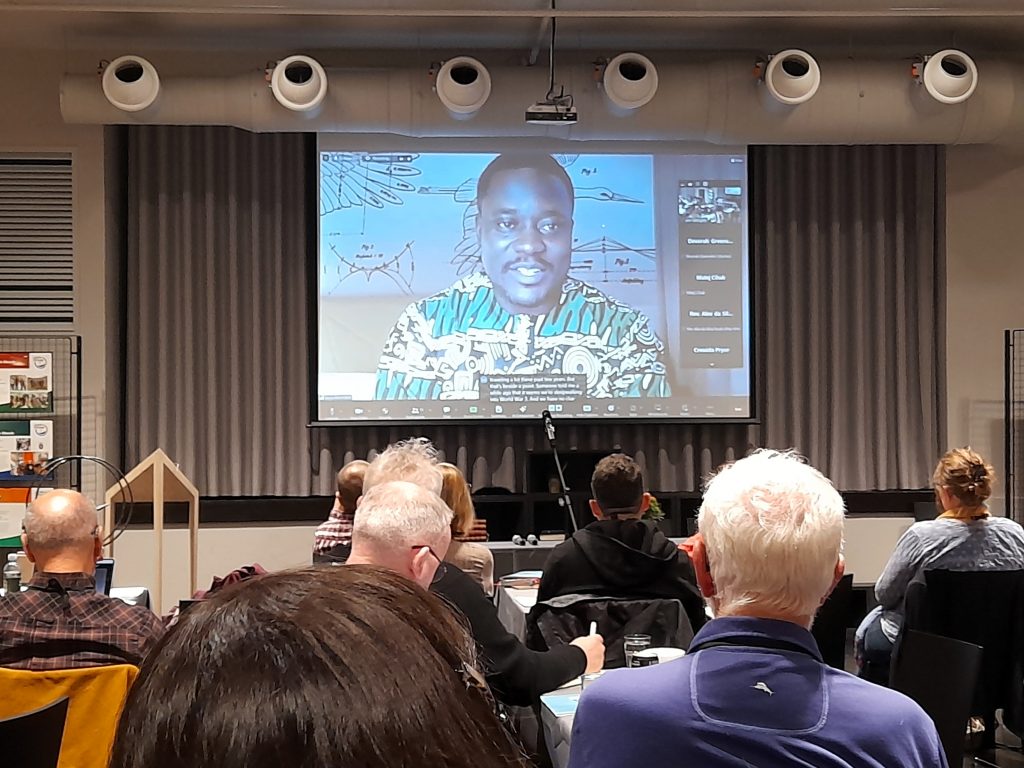
Our keynote speaker, Bayo Akomolafe, joined us online. A philosopher, writer, activist, professor of psychology, and executive director of the Emergence Network, his talk was by turns inspiring, challenging, difficult to grasp in one go (not necessarily a criticism), ranging from the stories told by his ancestors, to the world of microbes and fungi, to how we ‘do faith’ in an increasingly interconnected world. His talk, entitled: “Making Sanctuary Together: Faith in a more-than-human world” can be seen here: https://vimeo.com/uuainternational/lifkeynote
“In an increasingly interconnected world, in a world of fungi and microbes, in a world in which humans are problematically central, it seems we are forced to reframe faith as a post-humanist thing.”
“Making sanctuary… a vocation of ‘catching them where they fall’; thinking of losing faith as accompanying each other in loss, in grief, of seeking new pairings, of holding space for the fugitive.”
“Faith is an ongoing inquiry not a conclusion. It is sustained fidelity and commitment to collective questioning and discovery.”
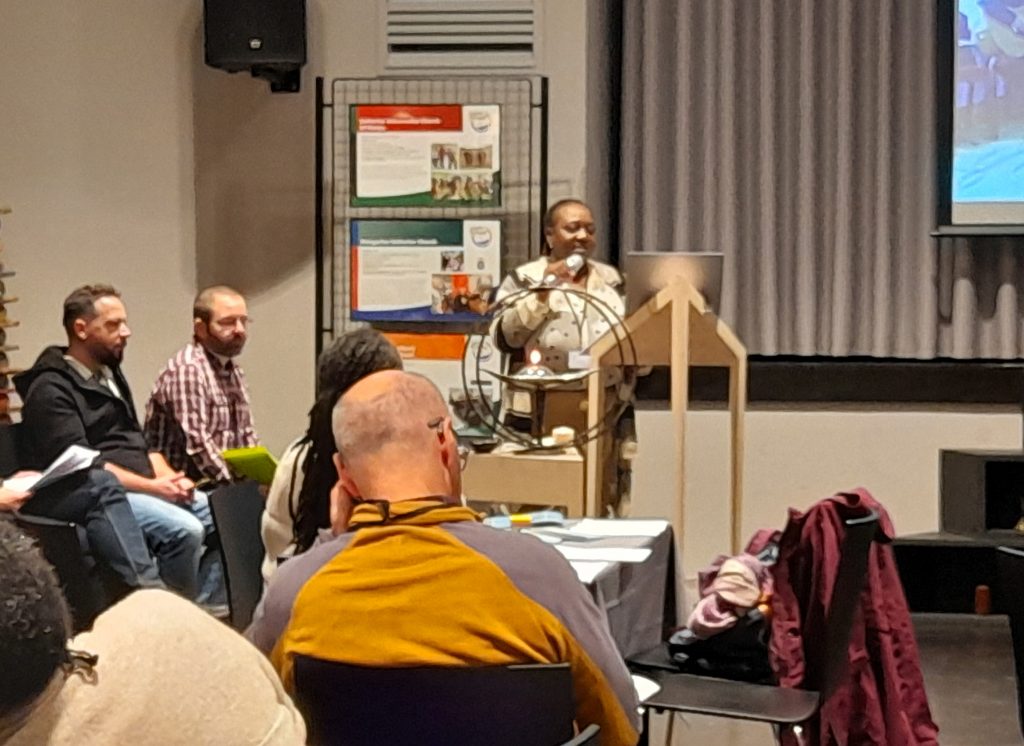
Our panel of Unitarian leaders from across the globe then discussed theological education, exploring what this means in a world radically different from that of our Unitarian forebears. A wide-ranging discussion, quotes included the following (the full discussion can be viewed online here: https://vimeo.com/uuainternational/praguepanel
“Not a small number of our members all over the world would appreciate lay leader education, based in our values, of course. It is important from my point of view not to start with the offer, but with the question of: what we need?” Kristyna Ledererová Kolajová
“I think the theological education that we need helps our Unitarian leaders to have a strength of not knowing, of holding that inquiry, in a way that’s deeply rooted.”
Elizabeth Slade
“No matter what community you come from, the world is changing under our feet. And whatever it is that is next for us, there are still people in the here and now who don’t want to be there and don’t want to go. How do we minister to them without blocking the urgent need for what is next?”
Rosemary Bray McNatt
“The question that is real in my mind, as I think about the future of theological education is how do we move from economies of exchange – in which there has to flow capital from one end to the next to make something feasible and happen, into economies of service – in which we understand what is needed and the particular life and ethical work to be done in our community.”
Elías Ortega
“There are younger generations who don’t see themselves as religious or church people, but they are still asking life’s big questions. They are still interested in where we came from, what we are here for, and where we may be going to, and how we can live our best lives.” Helen Mason
“Someone, somewhere on the African continent, learns about Unitarianism and is trying to learn and to understand. Where does that person learn from what is written from the UUA, from the UK and other places which are not Africa? And how does what the person has access to be translated into their own culture, their own context, and build something new and beautiful?” Mwbitsa (Fulgence) Ndagijimana
Written by Louise Reeve
