

Five Celebrations; Kwanzaa
This article was written by Tessa Forsdike, and first published in the Ipswich Unitarian Newsletter for February 2022. Find out more about Ipswich Unitarians here: Ipswich Unitarians
“During the Christmas holidays I learned of another cultural festival which was completely new to me. I was semi-familiar with Jewish, Muslim and Hindu festivals, which hold a similar importance for believers in those faiths as Christmas does for Christians. My granddaughter’s Montessori Nursery held a celebration with songs and dances at Christmas time and the programme made a point of wishing us all a happy holiday, whether Christmas, Hanukkah, Diwali, Ramadan, or Kwanzaa … and a Happy New Year to make sure they covered all options.
As I had never heard of the Kwanzaa celebration, I had to check on Google. It told me (via Wikipedia) that it is an annual celebration of African-American culture which takes place from December 26 to January 1,
culminating in a communal feast called Karamu, usually on the sixth day. It was created by activist Maulana Karenga, a Black nationalist and professor of Pan-African studies at California State University at Long Beach. It is based on African harvest festival traditions from various parts of Africa, including West and Southeast Africa.
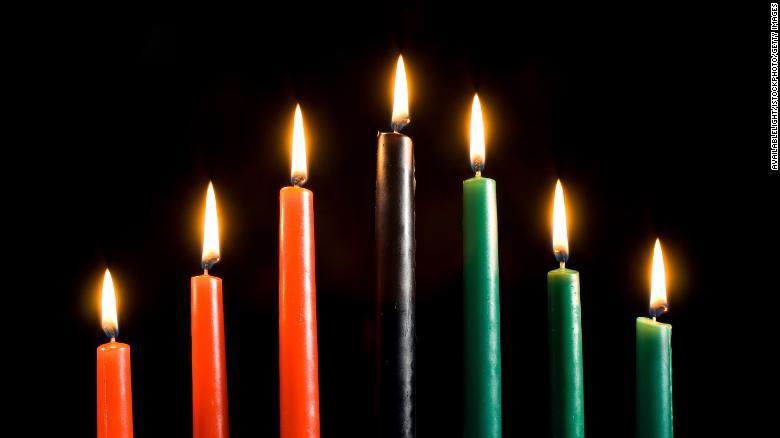
Kwanzaa was first celebrated in 1966, which is a long time not to have heard of it! It seems that the non-religious festival grew out of the political and Black Power struggles in the 1960s and 70s. It is based on African ‘first fruits’ traditions of giving the first produce to the Gods1. The name Kwanzaa is from the Swahili phrase, matunda ya kwanza. The rituals of the holiday promote Nguzo Saba, the “seven principles of African Heritage” that Karenga described as “a communitarian African philosophy”. Each day is
celebrated to mark one of the principles and a candle is lit on a seven-branched candelabra.
The principles are:
• Umoja (unity) — To strive for and maintain unity in the family, community, nation, and race.
• Kujichagulia (self-determination) — To define ourselves, name ourselves, create for ourselves, and speak for ourselves.
• Ujima (collective work and responsibility) — To build and maintain our community together and make our brothers’ and sisters’ problems our problems and to solve them together.
• Ujamaa (cooperative economics)—To build and maintain our own stores, shops, and other businesses and to profit from them together.
• Nia (purpose)—To make our collective vocation the building and development of our community in order to restore our people to their traditional greatness.
• Kuumba (creativity)—To do always as much as we can, in the way we can, in order to leave our community more beautiful and beneficial than we inherited it.
• Imani (faith)—To believe with all our heart in our people, our parents, our teachers, our leaders, and the righteousness and victory of our struggle.
Whatever our faith tradition (or none), these principles seem universal. As I delved further, I discovered there are some disputes about Maulana Karenga’s criminal record (he is currently on parole) as to whether the charges against him were due to political pressures and the rivalry between his organisation and the Black Panthers. This, whether true or not, does not detract from the ideas behind Kwanzaa. I do not know of anyone in the UK who celebrates this festival and would be interested to hear how
familiar with it readers are.”
Tessa Forsdike
1 Note from Louise Reeve – ‘first fruits’ appears to be a common practice in many religious and spiritual traditions, including ancient Greek, Roman, Hebrew, Christian, and Pagan. Find out more here: First Fruits
