

Introducing the Findhorn Foundation
Louise Reeve here, continuing to share some of my thoughts – this is an address from 2018 based on my trip to the Findhorn Foundation earlier that year.
“Most stories start with a leaving of home, a travel through strange lands, the coming-together of companions and the facing of new and challenging experiences. Though Scotland is not that strange, the journey I made to Findhorn Foundation from Newcastle upon Tyne is certainly epic, taking in the North East coastline, then cutting inline through the snowy Cairngorms and finally emerging on the Moray Firth coastline. The Findhorn Foundation sits on a sandy peninsula near Inverness. It is surprisingly warm in January, but this is relative to the rest of Scotland; I spent the week thankful that I had equipped myself with walking boots and a thermal hat from the Black’s store in Inverness.
The Findhorn Community is now nearly 60 years old. As I described earlier, like Unitarianism, its members hold many differing beliefs, but three founding principles in common:
• Inner Listening
• Work Is Love In Action
• Co-Creation with the Intelligence of Nature
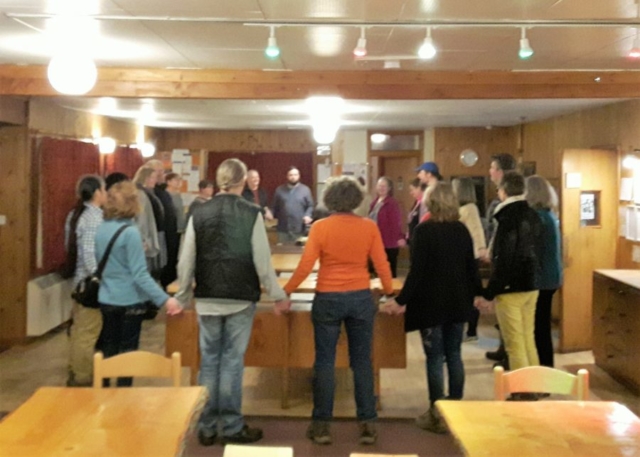
During Experience Week, we learned how the community lives all of these values. The Experience Week aims to give visitors, including the 17 Unitarians who had signed up to the Findhorn Unitarian Network (FUN) Week, the chance to experience some of the Community’s daily life and beliefs. Meditation and inner listening is so fundamental to Findhorn life that they have several sanctuaries devoted to providing people with space to do this. Every starts with an attunement like the one we did at the start of this week. By the end of the week, those of us in the FUN group were attuning like pros, holding hands and even hugging each other. It no doubt helps that Findhornians (if such a word exists!) also like to start their gatherings by lighting a candle!
Another fundamental aspect of the week was to join in sustaining the community by contributing to its maintenance through love in action. I was lucky; had the unusual opportunities to work with two Love-in-Action groups, the Park Home Care Team, and the Cluny Hotel Kitchen. (As a reminder, the Findhorn Community actually consists of two sites: the Park village, where the original founders lived, and the Cluny Hotel.) It may seem odd to pay to go on a week and do housework, as several people remarked to me, but not doing so would be to miss out on the chance to become part of the community and meet ordinary people from it. Some of my happiest moments from the week involved wielding the Henry Hoover around the Park’s Community Centre, and you can see a picture of this in the order of service.
Co-Creation with the Intelligence of Nature
The community describes this value as follows: “Our planet is alive and aware. By communicating and working with the rest of nature humans can find and bring new and creative solutions to life.”
Findhorn was founded on the visions of its creators, and the community aims to live in harmony with nature. We saw this in action in our tour of the community, visiting the famous gardens, the new ecovillage housing, and the famous “barrel houses”. These are houses made from giant whisky barrels, and date back to the early days of the community. Apparently there was some debate within the community at the time as to whether this was spiritually appropriate, as at the time they were a community which did not drink alcohol or take drugs. The argument was won when people pointed out that they were all about being eco-friendly and recycling, and the whisky barrels represented a local renewable resource.
We had two “focalisors” (facilitators) supporting us on our Experience Week, one of whom lives in an original barrel house. If you’re picturing a home like something out of ‘The Hobbit’, you’re quite right. Eating buttered oatcakes and drinking ginger and apple tea in Craig’s home was one of the highlights of our week!
Many at Findhorn also follow pagan traditions, and whilst we were there several of us took part in the celebrations of Imbolc or Brigid’s Day, which, as you may recall from our Spring Miscellany, occurs halfway between the winter solstice and spring equinox and is the celebration of the beginning of spring and new life as we emerge from the cold of winter. The Findhorn Imbolc celebration involves gathering in the Park Garden’s polytunnels and holding a short ceremony with attunements, readings and songs, followed by everyone present taking seeds from the service leader, holding them and blessing them, then planting them and covering them with earth. I like to think that the turnips I planted are growing there at present, and will one day nourish the community in the form of soup.
Among the many traditions associated with Brigid’s Day is the traditional passing through Brigid’s girdle chanting the blessing above, and hoping to be reborn for the new year to come. At the start of 2018, to be part of the Findhorn community even for a week was a privilege, and perhaps even the start of something new with Unitarianism.
Here are some quotes from other people who took part in the week:
One person really enjoyed everything about it: “Highlights were the wonderful vegetarian food and comfortable accommodation, Taizé chanting every morning at 8am in the Nature Sanctuary, early morning mediation in the Park Sanctuary, the wonderful full moon at Imbolc on 1st February and the community celebrations of it, a trip to Randall’s Leap, a stunning waterfall on the Findhorn River”.
One person’s positive comments were: “It’s well worth the travel. Attunement should be used everywhere, for everything! 3. Love in action transforms our obligations into joys (most of the time). We can, and do, change at any moment. We can always be better today than we were yesterday. My preconcieved ideas about what a didgeridoo sounds like have been completely blown away! It’s my new favourite instrument.”
Another attendee found the week challenging, which it is, and I’m aware that by changing some aspects of our worship today, I may have challenged some of us today. I’ve included this quote because it rang true to me:
“The experience would not be enjoyed by all Unitarians, given the difficulty many have with what they might dismiss as ‘New Age spirituality’, as they hold on perhaps a little too grimly to their much-valued ‘reason’ and need for ‘clearly-defined religious practice’. Indeed, one of the key things I discovered was that I had quite a bit more of that of that in me than I had realised, and was not nearly as ‘open’ to the spiritual paths of others as I had thought I was.”
One person’s favourite memories were: “Before setting off for the gardens in the morning, I went to the 8am Taize singing sessions held in the Nature Sanctuary. It was a joyful, uplifting way to start the day. Before starting work in the gardens and also at the end of the session, there would be an ‘attunement’ led by the ‘focaliser’ (team leader). Holding hands in the circle, I felt a deep connection to my inner self, to the others within the circle and with all that is.”
Another said he had taken away the following learning points and experiences
“1. I didn’t realise how global its reach was, with RPs [Resource People] in most countries round the world. These are people who have lived in Findhorn or visited several times and know the Foundation and Community well, and are enthusiastic about taking the inspiration they found here out into their own activities and local area.
2. Craig, one of our ‘focalisers’ who guided the group through our week, saying to us on last day that he liked us “crazy Unitarians” because he thought “they were a lot like us!”.
3. Love-in-Action turned out to be a quiet take-away for me. I’ve used it to turn chores into things which matter and have purpose. And it changes the quality of the work done, and reduces the stress of doing what needs to be done; for me anyway.”
One comment was: “I often felt a mutually non-judgemental encouragement of each other and supportive atmosphere within the group throughout my stay. It was very meaningful for me. It is something that is lacking in wider society, I feel, as we tend to passively rely on being entertained by TV / radio / concerts etc which misses out the social aspects of entertainment – the mutual exchange of talents and entertainment within a social group and the bonding that forms through this.”
Another said: “For me the take-away is love in action, to take time to put love into all that I do, which is not always easy when things feel like a chore. To think outside myself, about how this benefits the community – both local and global – and give love to the task at hand. Also, to take time and co-create in some way too. I am more inspired since Findhorn to find some space in nature (hopefully my garden, which is my next project), to breathe calm and peace into my being and doing.
Finally, I feel more connected to the Unitarian community through the friendships built by living with one another, and profoundly humbled by the passion and commitment of two young individuals to those suffering poverty and lack of jobs and opportunities in our UK communities, especially Scotland. Our discussions at night were a reminder that not everyone sees ways out, but needs help to get out. Thank you everyone.”
Finally, one attendee made the following personal observations:
“Through the workshops and general experience of living in the community for a week, I am inspired by a number of insights including:
- I am motivated to find my ‘tribe’ and greatly value the sense of belonging that comes with finding one.
- Unitarians are a great ‘tribe’ to hang out with. I found this with the wonderful people at my own Church, and now this extends to the great people I met on this experience week and on into the wider Unitarian community
- Learning new ways of inner listening that help me attune both to my own inner promptings and to reach out to others
She concluded by saying: “I’m sure each of us found lessons and practices to take home for ourselves and our chapels and churches to enrich our personal and organisational lives. How wonderful it would be if world powers adopted approaches we learned at Findhorn to address the world’s challenges!”
I hope that this short introduction to the Findhorn Community and its three principles to live by, and some of its spiritual practice, has helped us all think about how we might meet the challenges we face as individuals, and as a group, with hope, determination, and love.”
