

Revisiting Orkney – The History of Jack Green
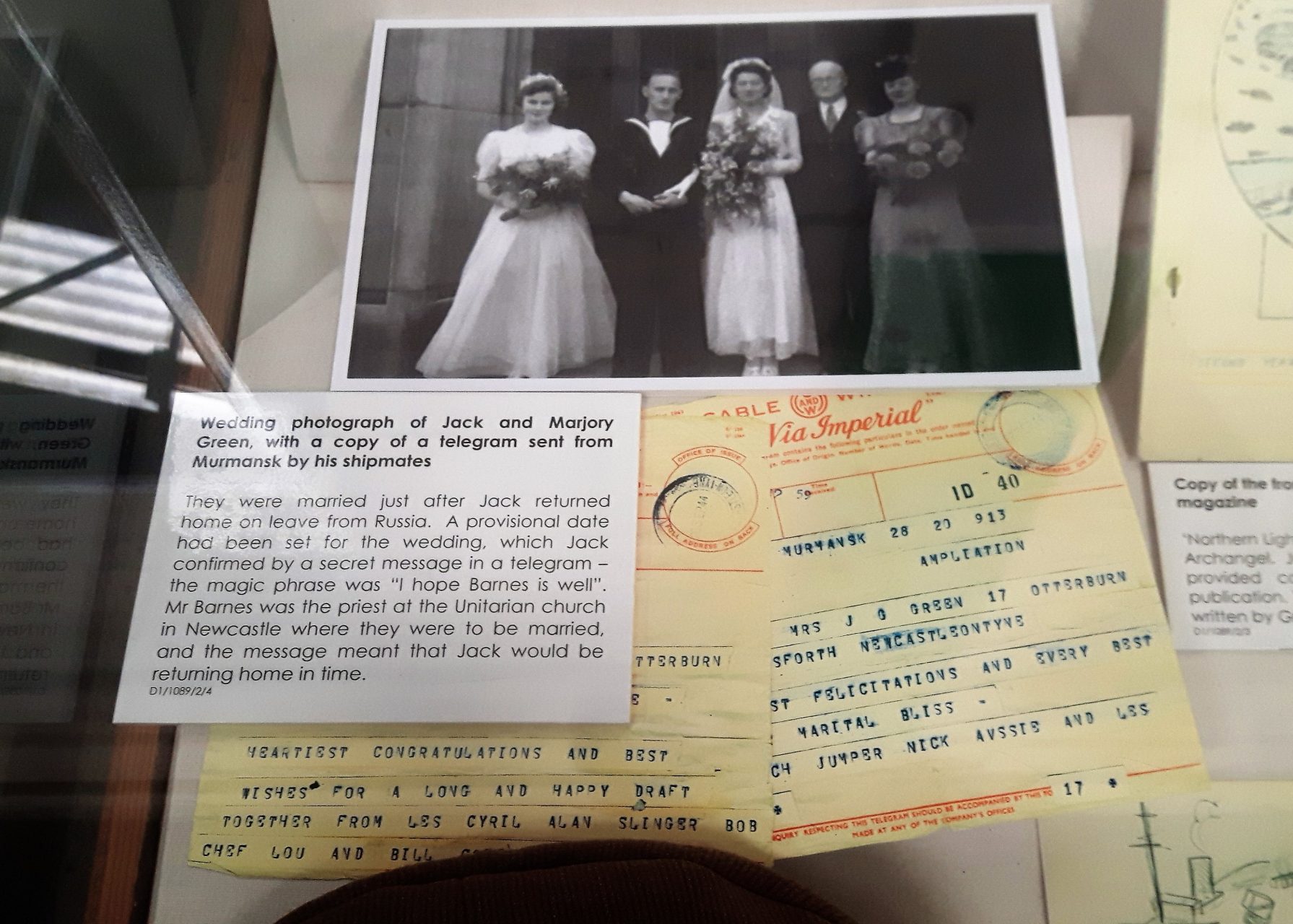
From Louise Reeve, from her original visit to Orkney in 2017:
“Herbert Barnes and the Scapa Flow Museum
Though many people might not associate ‘north of Scotland’ with ‘world-class scuba diving’, Scapa Flow in the Orkney Islands is famous throughout the scuba world as one of the world’s top wreck diving sites. The German High Seas Fleet was scuttled here in 1919, a deliberate act of sabotage to prevent the British being able to use the captured German warships (among the most advanced in the world at the time) as war prizes. It is one of few places in the world where WWI wrecks are (relatively) accessible to most scuba divers, and somewhere every serious British diver probably intends to visit at least once.
You may imagine then, that I was somewhat surprised when, in 2017, I called by the Scapa Flow Museum in Lyness during a week-long scuba diving trip to read about the history of the wrecks, and was confronted by a photograph of a familiar pair of gates. The nearby members of staff may have been surprised to hear someone pointing at a cabinet and shouting: “That’s my church!”
The gates in question are the entrance gates of our own Church of the Divine Unity (the pillars are clearly visible) with a wedding party standing before them, and the text accompanying the photograph explains why they appear in an Orcadian museum:
“Wedding photograph of Jack and Marjory Green, with a copy of a telegram sent from Murmansk by his shipmates.
They were married just after Jack returned home on leave from Russia. A provisional date had been set for the wedding, which Jack confirmed by a secret message in a telegram – the magic phrase was ‘I hope Barnes is well’. Mr Barnes was the priest* at the Unitarian church in Newcastle where they were to be married, and the message meant that Jack would be returning home in time.”
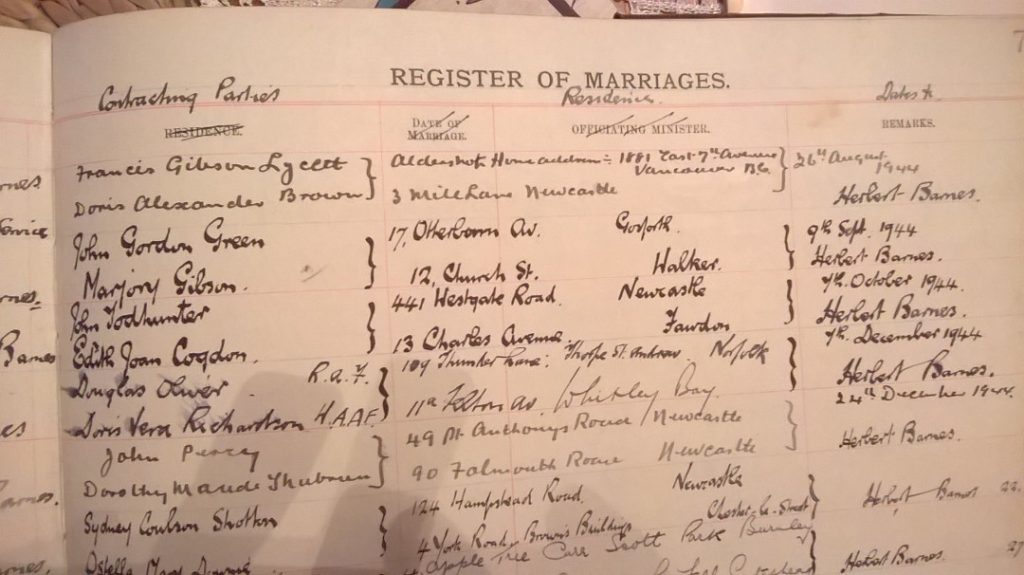
I obviously never met Rev. Herbert Barnes, whose ministry ended in 1951, but one of the senior members of our church was able to locate the marriage entry in the church registry – it can be seen in the photo below, and shows their full names: John Gordon Green, and Marjory Gibson. A fascinating and unexpected part of our history!”
* A copy of this article has been dispatched to the Orkney Museum, with the photograph of the marriage registry entry, and a note that Unitarian congregations have ministers, not priests. Here are the photographs:
“Arctic Convoys: Jack Green” – from his daughter, Judith Green
According to the notebook my father left, which you hold, he sailed from Scapa Flow on 23rd October 1943 on the Musketeer. The convoy comprised: Milne, Musketeer, Mahratta, Matchless, Savage, Scourge, Scorpion and Saumarez. They passed the Faroes on 24th October, Bear Island on 27th October, arrived Kola Inlet on 28th October, and Polyarnoe on 30th October 1943. When I read Richard Woodman’s book at Christmas, this puzzled me at first, as the convoys were suspended during this period. However I noted that several destroyers were involved in Operation FR :
“Operation FR was the passage of an escort group sent during the last week in October 1943 to bring back the accumulated merchantmen – the relieving force, in fact, for the ‘forgotten convoy’ and the weary naval personnel stationed in North Russia.” Woodman, 1944, Arctic Convoys, p342.
Woodman lists Musketeer as one of the nine destroyers in this group. This explains why the outward trip described in the notebook is relatively fast in comparison with the average escorted convoy.
However my father did not join these destroyers for their return trip. There are no notes about his return trip, and I do not know which convoy he travelled on, but the records say that his North Russia posting ended in August 1944. This would mean that he was in North Russia for 9-10 months. This fits with Woodman’s mention (p163) of communications ratings on nine-month postings at Murmansk and Archangel. My father was a signalman (you have his training record).
North Russia
I had the impression that my father enjoyed his time in Archangel / Murmansk, and got on well with Russians he met. I imagine it was much preferable anyway to being on a convoy. As the various accounts of the convoys say, there was a lot of spare time to be filled and boredom was probably the main problem. You can see from the documents, drawings and photos that I left with you some of the things my father did to fill his time:
- He did a lot of sketching. I would think that some of the sketches of military bases etc are possibly a unique source of evidence. My father was a copier rather than an original artist, so I guess he did the sketches mainly from photos (which would explain why there are several photos also in the collection). As well as ships and landscapes, he also did many drawings of film stars and other celebrities of the period (you have these sketches too).
- He helped to produce the base magazine. You have a copy of this – I think it says he was one of the art editors. One of his skills was drawing cartoons, so he was probably responsible for those.
- He learned to ski and watched football matches and other entertainment (there is an entrance ticket and a photo of a football match among the documents I left with you).
- He did mix with Russians. He learned some basic Russian, and still had a few phrases to the end of his life (I learned Russian at school, so I can confirm that his Russian phrases were accurate). He certainly visited a Russian ship (?) at some stage, as he wrote an article about it for the base magazine (I assume that this is why he kept that particular copy. Also it explains the Russian sailor’s hat-band in the collection).
Stories
My father did not talk much about his experiences on the convoys or in Russia. He wasn’t the type to complain, and his stories tended to be funny rather than painful or heroic. If I went by what he talked about, I would say that his two worst service experiences were:
- Having most of his teeth pulled out by a brutal navy dentist without benefit of anaesthetic (which left him with a lifelong fear of dentists, and a refusal ever to visit one again)
- Hearing of the death of his brother in a Japanese prisoner of war camp and downing a whole bottle of rum (with the result that he never drank rum again in his life).
I am afraid that we have very few Russian stories to pass on. Obviously he did go through the ceremony on crossing the Arctic Circle for the first time, as you mention, as there is a certificate in the collection, but he didn’t talk about it.
In addition to the snippets above, I can add the following:
- My father joined the navy as a volunteer because he knew that he would be conscripted sooner or later, and he wanted to have a choice about which service to join. He chose the navy because it was the safest – and then got posted on the Arctic Convoys which were about the most dangerous place to be posted. (He told this as a funny story.) He refused to learn to swim because he thought it would be better to die quickly than to perish slowly in freezing cold water.
- He taught himself to ski with rough wooden skis when in North Russia. He was out practicing on his own one day when he really got the hang of it and sped off down a slope. At that point he realised that at the end of the slope there was a sheer cliff falling into the sea, and that he did not know how to stop. He did manage to stop somehow, just before the precipice, by hurling himself sideways.
- My parents were married just after he returned home on leave from the convoys. There was a provisional date set for the wedding which my father confirmed by a secret message in a telegram – the magic phrase was “I hope Barnes is well”. Mr Barnes was the minister at the Unitarian church in Newcastle where they were to be married, and the message meant that my father was returning home in time. You have a copy of the wedding photo with him in his navy uniform, and a congratulations telegram from colleagues still at the base in Archangel.
Judith Green, 25 February 2012
Below is his cap badge, photographed by Louise Reeve


