

Fellowship and a new calendar
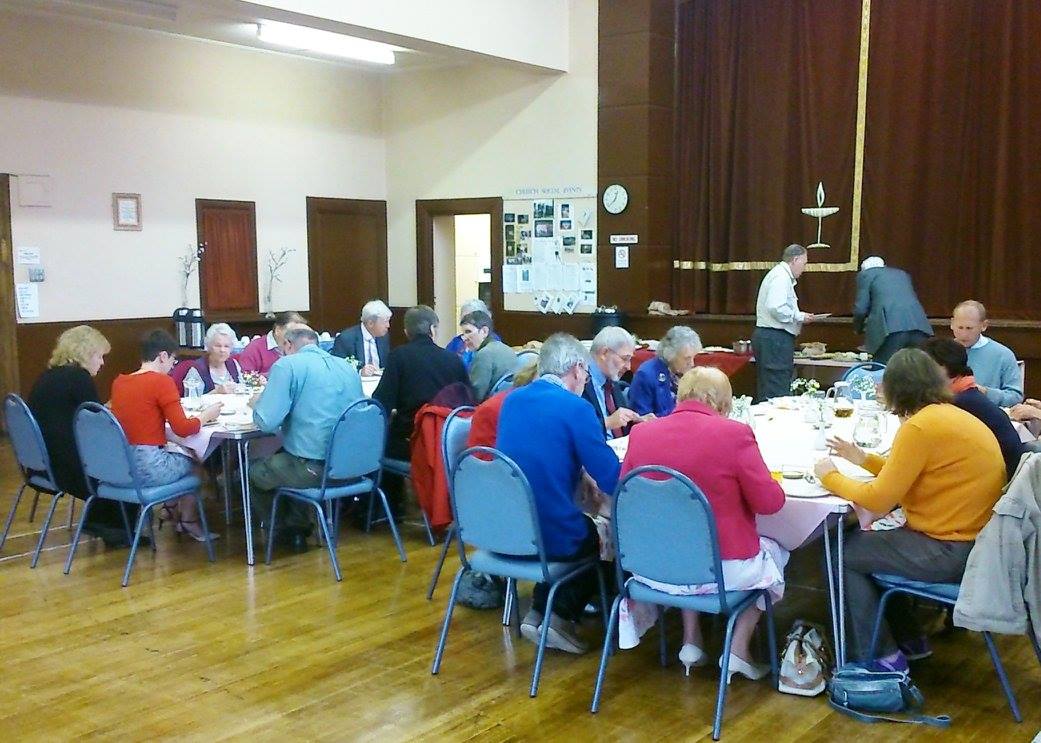
Hello everyone. Our Calendar for October-November 2023 is out, you can read it here: Calendar
An update on the future, from the calendar:
Newcastle Unitarians Fellowship
“We are thinking about making our church into a Fellowship to better suit the size and needs of our
congregation. We will still meet every Sunday, with one or two standard services a month, and
discussion-style services on the other Sundays. We hope this more informal arrangement will
better suit the lives of the congregation and still bring spiritual nourishment to the group. Where we meet may change in 2024, we will update attendees as soon as we can. Some services will still be available online. Any comments? Please email us at: info@newcastleunitarians.org.uk.”
As a bit more background, below is Louise Reeve’s address on this topic from our recent Fellowship Sunday service on 1st October 2023:
“Those of you who know me will know that I’m a big fan of fantasy and science fiction. If you’ve ever watched the TV series, ‘Game of Thrones’, you may remember a scene in which the young knight, Jon Snow, needs to persuade a group of hostile Northern tribes to form an alliance with him to resist an invading army. Having made an impassioned speech to the tribes and their leaders, he anxiously awaits their verdict. One of the most senior chiefs present looks at the sky and solemnly pronounces: “My ancestors would never have agreed to such a thing!”
She then shrugs and adds: “But they’re all dead, so who cares what they think?”
So, here we are in October 2023. As many of you may know, our building has been sold to Northumbria University, who intend to develop it into a lecture theatre with rooms for meetings, seminars and workshops. It is possible that one or more of the rooms may be named after famous former Unitarians, perhaps Herbert Barnes and Maurice Large. We do have the option to continue to meet in a University meeting room, or at another venue – we are reviewing our options.
Thinking about our congregation, our very first meetings of this congregation, prior to our becoming known as Unitarians, were in private meeting houses – as it says in the stone which greets visitors when they walk into the vestibule. At the start, we were not a church, but a fellowship. A fellowship is a somewhat different approach to spiritual gathering, compared to a church – it is essentially a self-organised group of fellow spiritual travellers who meet to share community and explore their spirituality. A member of a Unitarian Fellowship in the south of England describes it as: “The meaning of Fellowship is that you have a community of people that you get to know and feel supported by them.”
From our later ancestors, as it were – Rev. Herbert Barnes being the most notable – we inherited not only this building, but a classic nonconformist church setup. A building with halls to manage, a caretaker, a minister, management committee, Sunday Schools, subcommittees, rites of passage services such as christenings, weddings and funerals, social action, and the assumption that the church was a major part of people’s lives, not only spiritually, but socially, and even providing education and welfare – and also, I think, the unspoken assumption that a person couldn’t be a member of more than one congregation at a time. These are the assumptions built into the ‘church’ way of doing things, and many Unitarian congregations have inherited them. And I think this is a problem, if we don’t question it and ask whether it still works for us.
It’s sometimes said that the problem with modern humans is that we’ve got Stone Age bodies, medieval or Victorian systems of government, and Space Age technology. I sometimes think the problem we’ve got with modern congregations is that we’ve got Victorian models of worship and organisation, mid-20th century assumptions about what a church should do, and a society with radically different ways of communicating, understanding spirituality, and social needs.
GA Chief Officer, Liz Slade, commented at the General Assembly earlier this year: “The 2021 Census results show how rapid the change in religious culture has been in the UK. With 37% of people identifying as not religious (up from 14% twenty years ago) and 46% identifying as Christian (down from 72% in 2001), today’s context is very different to that in which many of our experienced leaders came to Unitarianism. The change has been swifter than most congregations could hope to keep adapting to, and so we face the predicament of the need to adapt to today’s culture without having the membership capacity to lead this change among all our congregations. It leaves us with a question of how we might work as a collective – whether there is a way to offer support in adaptation for a new lease of life, and how we might support those congregations that have naturally reached the end of their lifespan to leave a meaningful legacy. How can we engage each other well in these tender conversations about the future? How can we ask each other for help?
There is important nuance to consider beyond the Census results. We know that only around 5% of the population attend any church on a regular basis (data from UK Church Statistics), so even those identifying as Christian are mostly not taking part in regular worship. According to the Christian think tank Theos, among people identifying as ‘not religious’, only half say they don’t believe in God, and a third would identify as ‘spiritual’. And the Census shows the religions with biggest increases in membership as paganism and shamanism – traditions centred around holding nature as sacred. To me, all this shows that we have much that we can offer people, and perhaps a responsibility to reach those who otherwise wouldn’t identify as religious – and that our continually evolving faith allows us to adapt our ways of doing things without losing our core ethos.
Among those I meet in non-Unitarian settings, I see a huge appetite for and appreciation of what we stand for. In particular, there is a significant swell of interest from those who are most engaged with the climate crisis – both from those who are seasoned activists and know that burn-out arrives without a solid spiritual ground beneath them, and from those whose understanding of the scale of the crisis shows them that the materialist secular world may offer more problems than solutions.
As Unitarians and Free Christians, we are able to navigate the nuance of religious belief, just as we practise each week with the varied theologies and perspectives of those in our congregations. As the GA, we need to balance our support of existing congregations with our support of the congregations of the future – knowing these may look very different to those of the past.
Together, we must ensure that the flame continues to be passed generation to generation in ways it can be kept alive. I’ve appreciated the line from the composer Gustav Mahler, “tradition is not the worship of ashes but the preservation of fire”.”
I think that part of our problem as a movement is that we keep looking back to our glorious past, as we see it, comparing ourselves to our forebears, and ending up very discouraged. I think this is pointless. We are not living in the last century and people have got many other options for seeking spiritual growth, and also for what they can do on a Sunday.
I think that what we need to do, both as a movement, and as our congregation, right now, is ask ourselves: “What are the spiritual needs we are here to meet in 2023, and what’s the best way of doing it, with the resources we’ve got?” There’s a bit of a taboo in services, that you’re not really meant to mention practical matters. There are good reasons for this – this is spiritual time. I do, however, think it’s relevant in this service to commend the very hard work of generations of Management Committee members – the trustees of our church – to keep things going. When our current management committee met recently to discuss our future, we agreed on two things: 1) we want to be a well-run organisation, 2) nobody joins a congregation due to a burning desire to spend their free time mastering the finer points of property law and gas safety checks.
What we need to be in future is an organisation that meets people’s spiritual needs. That is why the Management Committee suggests that we should use this point in time to consider what we really need, and we think that the ‘Fellowship’ model is closer to it. If what we truly want is to gather together to explore our spirituality as a supportive community – and, I would suggest, doing so in partnership with other like-minded spiritual communities, such as other Unitarian congregations, Canny Yem, Northern Lights and the local URC congregations – let’s make that our goal. Let’s minimise the amount of time we have to spend filling in paperwork, and maximise our time together, both nurturing ourselves, and nurturing our communities through social action such as the climate justice march, and Northern Pride.
I should also add, being a fellowship is not necessarily a permanent or irreversible change. It does not preclude us having a minister at some point, and, if our numbers grew and we wished to purchase and run a building in future, we could do that too. Our goal as a congregation has always been:
“To promote a free and inquiring religion through the worship of God and the celebration of life; the service of humanity and respect for all creation; and the upholding of the liberal Christian tradition.”
I think that, alongside this, our goal must now be to seize this opportunity to let go of the past, and ask what works in the future.
